Understanding Roundabouts
What is a roundabout?
A roundabout is a circular intersection where traffic flows continuously counter-clockwise around a central island. No stop signs or traffic signals are needed.
Roundabouts offer some great benefits for our community:
🚙 Safer intersections: Fewer conflict points and naturally slower speeds make roundabouts significantly safer than traditional intersections.
🚦 Smoother traffic flow: No more sitting at a red light when there's nobody coming. Traffic keeps moving, which is great news on busy summer days.
💲 Lower operating costs: No electricity costs and less maintenance than traffic signals make roundabouts a smart long-term investment for the community.
🌎 Better for the environment: Less idling means fewer emissions. Small improvements add up across thousands of vehicles a day.
Our traffic engineers carefully study each intersection to find the best solution for that specific location, whether that's a roundabout or a traditional traffic signal.
How to safely navigate a roundabout
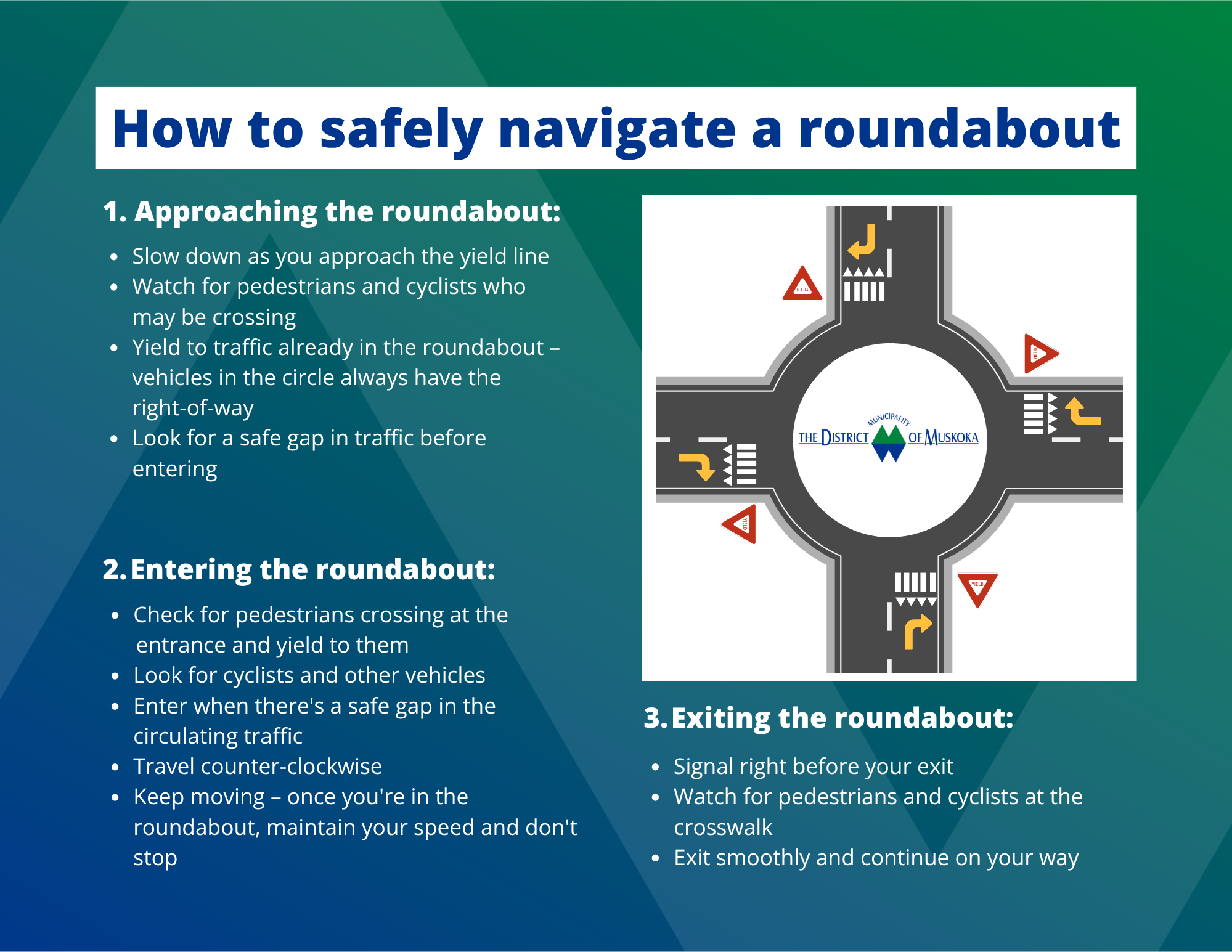
1. Approaching the roundabout:
* Slow down as you approach the yield line
* Watch for pedestrians and cyclists who may be crossing
* Yield to traffic already in the roundabout – vehicles in the circle always have the right-of-way
* Look for a safe gap in traffic before entering
2. Entering the roundabout:
* Check for pedestrians crossing at the entrance and yield to them
* Look for cyclists and other vehicles
* Enter when there's a safe gap in the circulating traffic
* Travel counter-clockwise, keeping to the right of the central island
* Keep moving – once you're in the roundabout, maintain your speed and don't stop
3. Exiting the roundabout:
* Signal right before your exit
* Watch for pedestrians and cyclists at the crosswalk
* Exit smoothly and continue on your way
A few things to keep in mind
🚛 Large vehicles: Please give trucks, buses, and other large vehicles extra space.
🚶♀️ Pedestrians: Never cross to the central island. Always use the designated crosswalks, wait for gaps in traffic, and only cross when it's safe to do so.
🚴 Cyclists: Experienced cyclists can ride through the roundabout alongside other vehicles. If you're riding through, move to the centre of your travel lane before entering and stay there until you've exited. Less experienced cyclists should dismount and walk their bikes through the crosswalks, following the same rules as pedestrians.
🚒 Emergency vehicles: If you hear sirens and haven't entered the roundabout yet, pull over to the right and let the emergency vehicle pass. If you're already in the roundabout, continue to your exit, then pull over to the right. Never stop inside the roundabout—this blocks traffic and delays emergency response.

Thank you for your contribution!
Help us reach out to more people in the community
Share this with family and friends